
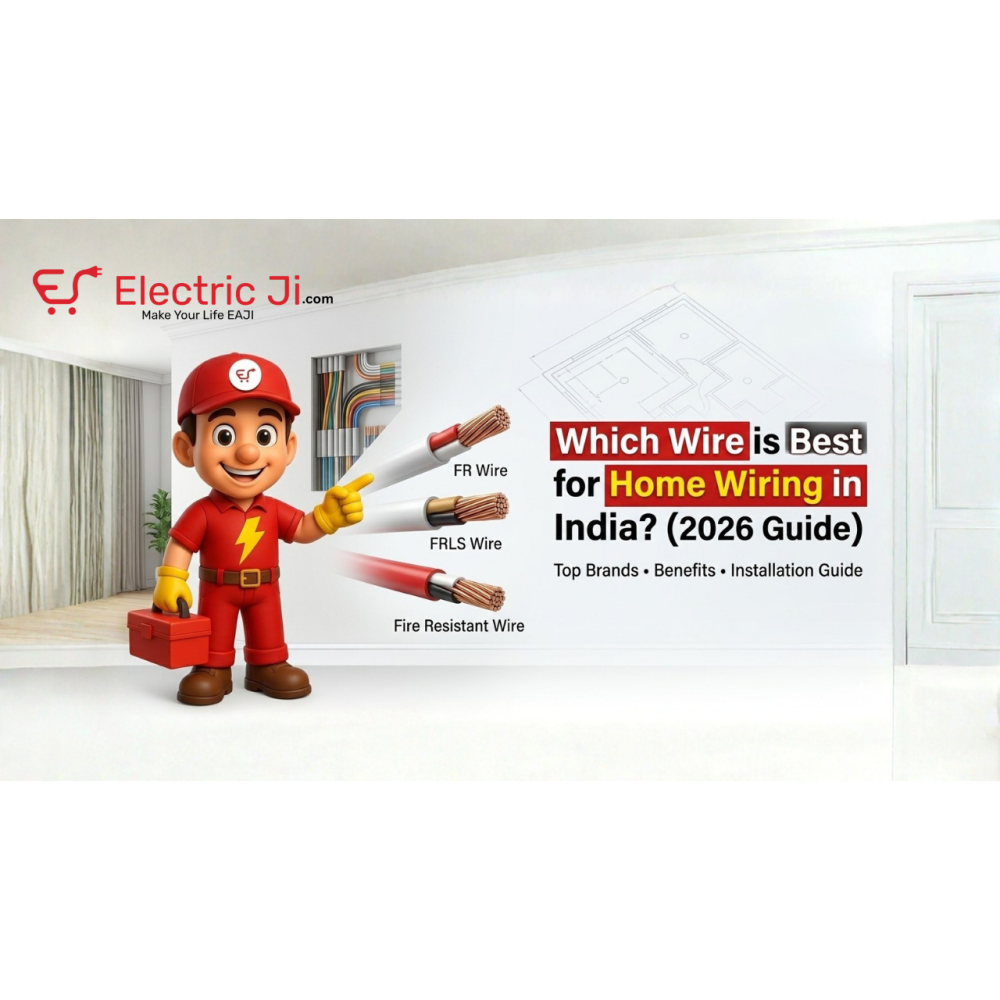
Most electrical problems in homes don’t begin with sparks.
They begin with small patterns.
The switchboard feels warm.
The AC wire heats up during peak summer.
The MCB trips when the geyser and induction run together.
Lights flicker when heavy appliances start.
Individually, these seem minor. Together, they point to something most homeowners never check whether their wiring type and wire size actually match their real appliance load.
In many Indian homes, appliances keep increasing.
More AC.
More geysers
Heavier kitchen equipment
EV chargers.
But the wiring inside the walls often remains unchanged.
The result is not immediate failure. It is gradual electrical stress.
Before blaming voltage supply or appliance brands, ask a more basic question:
Is your home using the right type of wire for the load you are putting on it?
This is where copper vs aluminium, correct wire size, and insulation category become critical not as technical terms, but as safety and capacity decisions that affect long-term reliability.
Here is the corrected table with the revised lifespan wording:
|
Feature |
Copper Wiring |
Aluminium Wiring |
|
Conductivity |
Higher |
Lower |
|
Heat Generation |
Lower |
Higher |
|
Connection Stability |
Strong, maintains tight joints |
Prone to loosening over time |
|
Voltage Drop |
Lower |
Higher |
|
Lifespan |
Generally 40+ years (depending on wattage, load distribution, and usage patterns) |
Generally 20 - 30 years (may reduce under heavy load) |
|
Safety for High Load |
Safer for continuous heavy appliances |
Risk increases under sustained load |
|
Cost |
Higher initial cost |
Lower initial cost |
FR vs FRLS vs HRFR (Quick Comparison)
|
Wire Type |
Best For |
Copper Recommendation |
|
FR |
Light-load circuits |
Can be used in copper; aluminium not recommended for long-term stability |
|
FRLS |
General household wiring |
Copper strongly recommended for safety and durability |
|
HRFR |
Heavy-load appliance circuits |
Copper highly recommended for continuous heavy-load performance |
Insulation type determines how safely a wire behaves during overheating or short-circuit conditions.
What Is FR Wire?
FR (Flame Retardant) wire resists catching fire and slows flame spread.
It is suitable for light-load circuits handling 3 - 5 appliances on a single line.
Suitable For
-
3 - 6 LED lights
-
1 - 2 ceiling fans
-
2 - 3 low-power devices (TV, router, chargers)
-
Bedrooms without heavy appliances
Typical load: Up to 1.5 - 2 kW
Important Safety Note
Never connect too many or multiple high load appliances on the same line.
Overloading a single circuit increases heat buildup in the conductor, weakens insulation over time, and significantly raises fire risk.
Each heavy appliance should have a properly rated, dedicated circuit.
Benefits
-
Slows flame spread
-
Cost-effective for light circuits
-
Adequate for basic residential areas
-
Suitable where heavy appliances are not connected
FR wire is not recommended for ACs, geysers, or kitchen heavy-load circuits.
What Is FRLS Wire?
FRLS (Flame Retardant Low Smoke) wire reduces both flame spread and smoke emission.
It is suitable for 4 - 8 appliances operating on the same circuit.
Suitable For
-
1 LED TV
-
1 set-top box
-
1 Wi-Fi router
-
1 sound system
-
4 - 6 LED lights
-
1 - 2 ceiling fans
-
1 air conditioner (on properly sized circuit)
Typical simultaneous load: 2 - 3 kW
Important Safety Warning
Do not connect multiple high-load appliances on the same circuit.
Appliances such as air conditioners, geysers, heaters, and induction cooktops draw high current continuously.
When more than one such appliance operates on a single line, the combined current can exceed the wire’s rated capacity.
This leads to excessive heat buildup inside the conductor.
Sustained overheating weakens insulation, loosens terminals due to thermal expansion, and increases the risk of MCB tripping or electrical fire.
Each high-load appliance must be connected to a properly rated, dedicated circuit with appropriate wire size and breaker protection.
Benefits
-
Slows flame spread
-
Produces significantly less smoke
-
Emits fewer toxic fumes
-
Improves safety in enclosed apartments
-
Recommended for general home wiring in modern flats
In enclosed spaces, smoke inhalation risk can be more dangerous than flames.
What Is HRFR Wire?
HRFR (Heat Resistant Flame Retardant) wire is built for higher continuous heat resistance.
It is suitable for 1–3 high-wattage appliances on a dedicated circuit.
Suitable For
-
1 air conditioner (1–1.8 kW or higher)
-
1 geyser (2 kW)
-
1 induction cooktop (1.5–2 kW)
-
1 microwave oven (1–1.5 kW)
-
1 washing machine (0.5–1 kW)
-
EV charger (dedicated line)
Typical dedicated circuit load: 2 - 4 kW per line
Benefits
-
Higher heat resistance
-
Performs better under continuous heavy load
-
Reduces insulation breakdown risk
-
Safer for kitchens and AC circuits
-
More durable under sustained current
What Is the Correct Wire Size for Home Wiring?
Wire size (in sq mm) determines how much current a circuit can safely carry.
General residential guidelines:
-
1.0 – 1.5 sq mm → Lighting circuits
-
2.5 sq mm → Plug points
-
4 – 6 sq mm → ACs and geysers
-
6 – 10 sq mm → Main supply lines
Using thinner wire for heavy appliances does not cause instant failure.
It causes slow internal heating.
Over time, insulation weakens. Connections loosen. Risk increases.
The system usually tolerates overload quietly until it doesn’t.
Signs Your Wiring May Be Undersized
MCB tripping frequently
Switchboards heating up
Wires feeling warm under load
Lights dimming when AC starts
Burning smell near heavy appliances
Running 2+ ACs daily
If you are adjusting appliance usage to avoid tripping, your wiring is already under pressure.
Appliance Load Matters More Than Apartment Size
When choosing the best wire for home wiring in India, total connected load matters more than whether your home is 2BHK or 3BHK.
Standard Usage (Up to 3 kW)
Typical load: 1.5 - 3 kW
-
Lights and fans
-
Refrigerator
-
TV
-
Washing machine
-
1 AC used occasionally
Light-load homes can function safely with correctly sized copper and FR/FRLS wiring.
Medium Usage (3–6 kW)
Typical load: 3–6 kW
-
2 ACs
-
1–2 geysers
-
Induction cooktop
-
Standard lighting load
If 2–3 heavy appliances run together regularly, proper wire sizing and insulation become critical.
High Usage (Above 6 kW)
Typical load: 6–10 kW or more
-
3 ACs
-
2–3 geysers
-
Induction + oven
-
Dishwasher
-
EV charger
Simultaneous usage can easily exceed safe limits for undersized wiring.
A 2BHK with 7 kW connected load may require stronger wiring than a 3BHK running only 2.5 kW.
The decision should always be based on total connected load — not apartment size.
What Is the Cost Difference?
Cost is the main reason homeowners choose cheaper wiring.
Upgrading to high-quality copper or better insulation increases initial cost.
But compare that with:
-
Appliance repair expenses
-
Rewiring damaged circuits
-
Fire risk
-
Insurance complications
The upfront savings are small.
The long-term risk inside the walls is not.
Risks of Choosing the Wrong Wire
When wire type and load do not match, stress builds silently.
Overheating Wires
Continuous overload generates internal heat.
Insulation Breakdown
Weak insulation cracks over time.
Fire Risk
Loose terminals and overheated conductors increase ignition risk.
Appliance Damage
Voltage instability affects compressors and circuit boards.
Electrical systems tolerate overload quietly, until they don’t.
How Electric Ji Helps You Choose the Right Wiring
Electric Ji electricians guide homeowners in understanding their actual electrical load, circuit capacity, and future expansion needs before recommending any changes. The focus is not on temporary fixes like tightening a loose wire or replacing a single fitting. The goal is to implement future-ready solutions that prevent recurring electrical stress and costly failures.
Electric Ji evaluates :
-
Total connected appliance load
-
Circuit distribution and balancing
-
Wire gauge suitability
-
Insulation type requirement (FR, FRLS, HRFR)
-
Distribution board capacity
Concealed wiring inside the walls is also inspected, not just visible fittings. Hidden stress points, overheating risks, and load imbalance are properly assessed rather than assumed.
Electric Ji offers a Home Safety Pack designed for long-term protection and cost control. With this plan, you receive four inspections per year, structured according to your BHK size and appliance usage level.
This ensures:
-
Early detection of overload risks
-
Prevention of insulation damage
-
Monitoring of concealed wiring health
-
Reduced chances of sudden breakdown
-
Lower long-term repair and rewiring costs
Instead of paying large amounts for emergency repairs or major rewiring later, periodic inspections help identify small issues before they become expensive problems.
The objective is not just to stop MCB tripping.
It is to ensure your wiring type, size, and insulation match your real household demand today and in the future.
Final Clarity
Copper is actually required everywhere.
Larger wire is not automatically better.
FR, FRLS, and HRFR are not interchangeable.
The correct choice depends on:
-
Total connected load
-
Simultaneous appliance usage
-
Future expansion
-
EV or solar installation plans
Electrical failures rarely appear without warning.
They build quietly inside the walls as usage increases.
If your home feels electrically restricted, it is not random.
It is a signal.
Frequently Asked Questions (FAQ’s)
1. What is the difference between FR, FRLS, and HRFR wires?
FR vs FRLS vs HRFR (Quick Comparison)
|
Wire Type |
Best For |
Copper Recommendation |
|
FR |
Light-load circuits |
Can be used in copper; aluminium not recommended for long-term stability |
|
FRLS |
General household wiring |
Copper strongly recommended for safety and durability |
|
HRFR |
Heavy-load appliance circuits |
Copper highly recommended for continuous heavy-load performance |
2. Which wire is best for home wiring?
For modern homes with multiple appliances, FRLS or HRFR wires are safer choices than basic FR wires.
3. How many heavy appliances can FR wire handle?
FR wire is generally suitable for 1–2 heavy appliances per dedicated circuit, depending on wire gauge and load calculation.
4. Is FRLS wire necessary for small apartments?
Yes. Even in small apartments, low-smoke wiring improves safety during electrical fires.
5. What happens if I use low-quality wiring?
Poor wiring increases overheating risk, voltage drop, insulation damage, and fire hazards.
6. How long does copper wiring last?
Copper wiring generally lasts 40+ years under normal conditions, depending on load, installation quality, and usage patterns. However, we at Electric Ji recommend planning inspections or partial rewiring within 20–30 years.The reason is simple.
Not all wires sold in the market today are made with high-purity copper. Due to intense price competition, some manufacturers compromise on copper quality, strand thickness, or insulation standards to reduce cost. These compromises are not visible during installation but can affect performance and durability in the long run.
Lower copper purity increases resistance.
Higher resistance means more heat.
More heat reduces lifespan.
So while true high-grade copper wiring can last 40 years or more, real-world conditions and market quality variations make 20–30 years a safer practical benchmark for modern installations.
7. How long does aluminium wiring last?
Generally 20–30 years, and lifespan may reduce under heavy continuous load.
8. Why does wiring heat up?
Heating occurs due to overload, poor connections, undersized wire gauge, or insulation degradation.
9. Can old wiring handle modern appliances?
In most cases, no. Older wiring systems were not designed for today’s high appliance density.
10. How often should home wiring be inspected?
Ideally, wiring should be inspected at least once a year, or twice in high-load homes.
11. What is voltage drop in home wiring?
Voltage drop is the reduction in voltage as electricity travels through a wire, often due to long runs or undersized cables.
12. Why are copper wires preferred over aluminium?
Copper wires are preferred over aluminium because they have higher conductivity, which means they carry current more efficiently, generate less heat, and provide better long-term reliability. Copper also offers stronger joint stability, so connections remain tight and safe over time. Many people choose aluminium because it is cheaper and seems like a temporary cost-saving option, but aluminium carries less current for the same size, heats up faster, and expands and contracts more, which can loosen connections and increase fire risk. Although copper is slightly more expensive, it is more power saving, provides better safety, handles load more securely, and is a far better long-term investment for home wiring.
13. Is higher wire cost worth it?
Yes. Higher-quality wiring reduces long-term risk, maintenance costs, and fire hazards.
14. Can concealed wiring inside walls fail?
Can concealed wiring inside walls fail?
Yes, it can. Insulation ageing, overheating, or poor installation can slowly damage wires hidden inside walls. The real problem is you won’t see the warning signs until something goes wrong and fixing concealed wiring means breaking walls and spending heavily because upgrading later is expensive and messy.
That’s why it’s better to install high-quality copper wiring from the start.Good wiring is not an expense it’s future protection and safety.
15. What is the biggest cause of electrical fires in homes?
Overloaded circuits and substandard wiring insulation are major causes.
16. Should every heavy appliance have a separate circuit?
Yes. Appliances like ACs, geysers, ovens, and washing machines should ideally have dedicated circuits.
17. Does wire thickness matter?
Yes. Thicker wires (higher gauge capacity) handle higher current safely with less heat buildup.
18. Is FRLS wire fireproof?
No wire is completely fireproof. FRLS resists flame spread and reduces smoke, improving evacuation safety.
19. When should wiring be replaced?
If your home is over 10 - 15 years old, shows frequent tripping, heating, or voltage fluctuation, inspection is necessary.
20. How do I know if my home wiring is future-ready?
A proper load calculation, circuit evaluation, and insulation type assessment can determine whether your wiring supports future appliance expansion.