
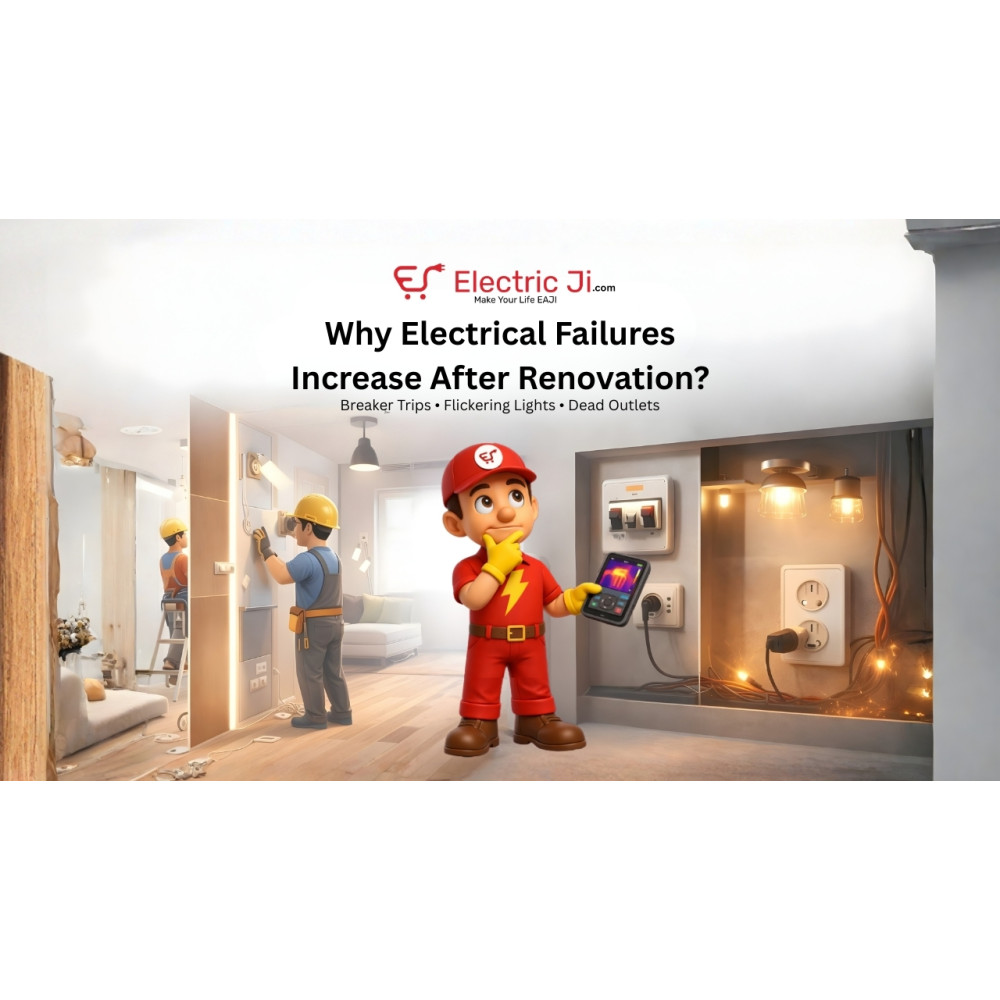
Renovation makes a house look new.
Fresh paint.
False ceiling.
Designer lights.
Modular kitchen.
Extra AC.
Everything feels upgraded. But behind the walls, something else changes.
Electrical load increases.
Wires get extended.
Junction boxes get disturbed.
Old protection systems are expected to handle new demand.
Everything works. Until one evening.
Breaker trips.
Lights flicker.
One room suddenly has no power.
You assume it’s temporary.
But electrical failures after renovation are rarely random. They happen when demand increases and electrical capacity is not reassessed.
What Actually Changes During Home Renovation?
During renovation, most Indian homeowners add:
-
Extra AC units
-
Geysers
-
Microwave or OTG
-
Decorative and cove lighting
-
Extra plug points
-
Chimney and kitchen appliances
-
Automation systems
But what usually stays the same?
-
Wire size
-
MCB ratings
-
Distribution board configuration
-
Earthing system
-
Sanctioned load
Load increases. Infrastructure often does not. That gap creates stress.
Why Does Breaker Trip After Renovation?
Common searches:
-
“Why is MCB tripping after renovation?”
-
“New wiring but breaker keeps tripping?”
-
“MCB trips when AC and microwave run together?”
The breaker is not weak. It is protecting you.
Common reasons:
-
Multiple heavy appliances running together
-
Old circuits carrying new load
-
Undersized wiring
-
Wrong MCB rating
-
Loose neutral
-
Poor load planning
Repeated tripping means load and circuit capacity do not match.
Why Are Lights Flickering After Renovation?
Many people search:
-
“Lights flicker after false ceiling work”
-
“LED lights blinking when AC starts”
-
“Voltage fluctuation after home renovation”
Lights flicker when:
-
AC starts
-
Geyser turns on
-
Microwave runs
Possible reasons:
-
Loose neutral
-
Voltage drop under higher load
-
Phase imbalance
-
Shared overloaded lighting circuit
If lights react to appliance startup, your system is operating under pressure.
Why Is One Room Without Power After Remodel?
Search patterns:
-
“One room no power but others working”
-
“Dead socket after drilling wall”
-
“Switchboard not working after renovation”
Common causes:
-
Drilling cut a concealed wire
-
Junction box connection loosened
-
Terminal not tightened properly
-
Insulation damaged during ceiling work
Electrical circuits run room-wise. If one circuit fails, only that area loses supply.
Using extension boards is not a solution. It increases load on other circuits.
Why Electrical Problems Increase After Home Improvement
After renovation, three things usually happen:
-
Connected load increases.
-
Wiring gets disturbed.
-
Protection systems remain unchanged.
Old electrical systems are forced to carry modern demand.
For a few weeks, everything feels normal. Then stress begins showing.
-
Frequent tripping
-
Warm switchboards
-
Voltage fluctuation
-
Partial power failures
Electrical systems show discomfort before failure.
Warning Signs After Renovation You Should Not Ignore
-
Breaker tripping repeatedly
-
Lights dimming when appliances start
-
Burning smell near distribution board
-
Warm switches or sockets
-
AC shutting down unexpectedly
-
Sudden voltage fluctuation
Resetting the breaker again and again does not remove wiring stress. It only delays visible failure.
Risks of Ignoring Post-Renovation Electrical Stress
Overheating wires
Continuous overload builds internal heat inside concealed wiring.
Fire risk
Loose terminals combined with increased load create serious hazards.
Appliance damage
AC compressors and PCBs fail under unstable voltage.
System instability
Repeated tripping weakens protection devices over time.
Renovation improves appearance. Skipping electrical planning increases risk silently.
How Electric Ji Stabilizes Post-Renovation Electrical Systems
Instead of reacting after failure, Electric Ji evaluates:
-
Total connected load after renovation
-
Simultaneous appliance usage
-
Distribution board condition
-
Wire gauge suitability
-
MCB ratings vs actual load
-
Neutral and earthing integrity
-
Overloaded circuits
-
Phase balance (if applicable)
The goal is not just stopping tripping. It is aligning load with capacity.
Corrections may include:
-
Circuit segregation
-
Proper MCB replacement
-
Dedicated wiring for heavy appliances
-
Distribution board upgrade
-
Sanctioned load increase
Renovation is complete only when electrical capacity matches new demand.
Final Clarity
Renovation increases electrical demand.
Wiring must grow with it.
Breaker trips, flickering lights, and dead outlets after remodel are not random problems. They are stress signals.
When load aligns with wiring capacity and protection systems are configured correctly, electricity becomes stable again.
Renovation upgrades appearance.
Electrical planning secures safety.
Frequently Asked Questions (FAQs)
1. Why do electrical problems start after renovation?
Because new appliances increase load but wiring and MCB configuration often remain unchanged.
2. Why is my MCB tripping after installing a new AC?
The existing circuit may not be designed for additional load.
3. Can drilling during renovation damage concealed wiring?
Yes. Hidden wires can be cut or insulation damaged.
4. Why are LED lights flickering after false ceiling installation?
Loose neutral, voltage drop, or overloaded lighting circuits are common reasons.
5. Why does only one room lose power after renovation?
That room likely runs on a separate circuit that got disturbed.
6. Is new wiring automatically safe after renovation?
Only if correct wire size and proper load calculation were done.
7. Can false ceiling work cause electrical faults?
Yes. Junction boxes are often shifted or disturbed.
8. Why does my AC shut down after renovation?
Voltage instability due to overload may trigger internal protection.
9. Should I upgrade the distribution board after renovation?
If load has increased significantly, upgrading may be necessary.
10. Is repeated breaker tripping normal in new wiring?
No. It indicates load planning mismatch.
11. Why does the switchboard feel warm after renovation?
Excess current flow or loose internal connections.
12. Can old earthing cause problems after adding new appliances?
Yes. Higher load demands stronger grounding.
13. Does decorative lighting increase electricity load?
Individually minimal, but combined with heavy appliances it adds pressure.
14. Is changing only the MCB enough to stop tripping?
No. Wiring capacity must also match load.
15. Can DIY electrical changes during renovation cause issues?
Yes. Improper tightening and wrong connections create hidden stress.
16. Why is voltage fluctuating after home improvement?
The system may be operating near maximum capacity.
17. Should I get an electrical load check after renovation?
Yes, especially after adding ACs, geysers, or kitchen appliances.
18. Can overloaded circuits cause fire after renovation?
Yes. Continuous overheating increases fire risk.
19. How can I prevent electrical failures after renovation?
Recalculate total load and align wiring, MCB ratings, and DB configuration properly.
20. When should I call for a full electrical inspection after renovation?
If you notice repeated tripping, flickering lights, warm boards, or voltage instability.