
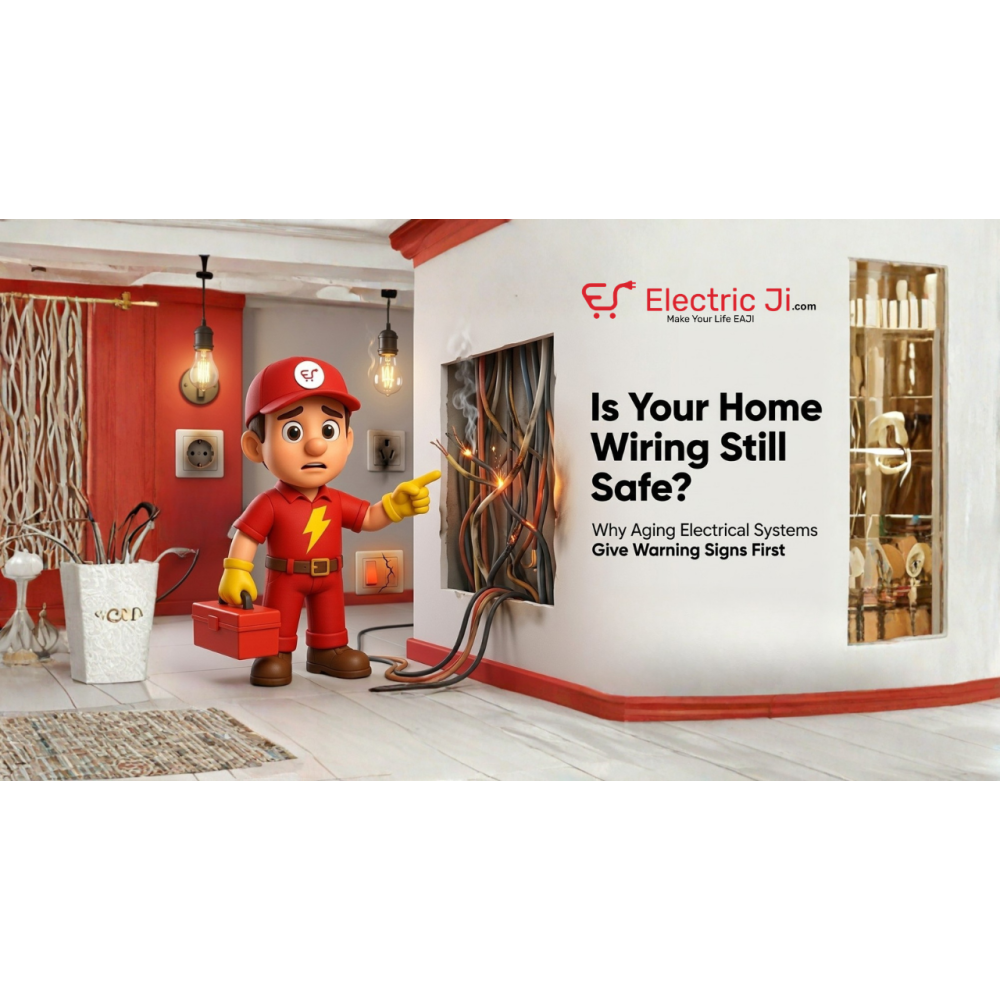
In most Indian homes, wiring is invisible so it is ignored.
If the lights are working, everything must be fine.
If AC runs, the wiring must be strong.
If the geyser heats water, the system is okay.
So the conclusion becomes simple:
“Sab theek hai.”
But electrical systems do not fail suddenly.
They give warning signs first.
Behind the walls:
Wires heat slightly more than they should
Insulation slowly weakens
Connections loosen gradually
Load increases every year
The system keeps adjusting quietly.
Until one day it cannot.
Why Old Home Wiring Becomes Risky Over Time?
Common searches by homeowners:
“Is 15 year old wiring safe?”
“Should I replace wiring after 10 years?”
“How long does house wiring last in India?”
There is no fixed expiry date for wiring.
But wiring ages under stress, which is why regular inspection becomes important.
In 10–15 years, wiring has already faced:
Thousands of heating and cooling cycles
Voltage fluctuations
High starting current from ACs and pumps
Increased appliance usage
If appliance load has doubled but wiring stays the same, the safety margin reduces even if everything still looks normal.
How Indian Homes Have Changed
10–15 years ago:
One AC
One geyser
Basic lights and fans
TV and refrigerator
Today:
2–3 ACs
Multiple geysers
Microwave, OTG, induction
Washing machine
Refrigerator running 24/7
Inverter systems
Water pumps
Sometimes EV charging
Lifestyle upgraded. But wiring often did not.
Most appliance decisions are based on:
-
Comfort
-
Brand
-
Interior design
-
Decorative lights
-
Available wall space
Rarely does anyone ask:
Can my wiring handle this load?
Is the circuit designed for this?
Is the distribution board balanced?
Do heavy appliances have dedicated lines?
That mismatch creates hidden stress.
Why Does MCB Trip Repeatedly?
Popular searches:
“MCB keeps tripping in house”
“MCB trips at night only”
“Why do breaker trips again and again?”
People usually assume:
Voltage issue
Faulty MCB
Power supply problem
But usually the MCB is doing its job.
Repeated tripping often means:
Overloaded circuit
Aging or weak wiring
Loose internal connections
Wrong breaker sizing
Load imbalance
Resetting it does not remove internal stress.
It only postpones visible failure.
Why Do Lights Flicker When AC Starts?
Common search phrases:
“Lights flicker when AC turns on”
“Voltage drop in house at night”
“LED lights blinking problem”
This can indicate:
Voltage drop
Loose neutral
Load imbalance
Concealed wiring stress
Repeated flickering is not just a bulb issue.
It reflects electrical strain.
Warm or Sparking Switchboard – Is It Dangerous?
Search patterns:
“Switchboard getting hot”
“Spark while plugging in socket”
“Burning smell from switchboard”
If you notice:
Warm switches
Small sparks
Temporary burning smell
Black marks near socket
It may indicate:
Loose terminals
Overheating conductors
Insulation damage
Overloaded circuit
These are direct fire risk signals.
Loose Wiring Connections Inside Switchboards
Another common issue in many homes is loose wiring inside switchboards or distribution boards.
Sometimes during installation or repair, electricians don’t properly tighten or lock the wire connections.
Wires remain slightly loose inside the terminal.
Everything still works, so most people assume there is no problem.
But loose connections create resistance, and resistance creates heat and power loss.
When the connection is loose, electricity does not flow smoothly through the wire.
The system starts wasting energy as heat, and over time the wiring gets stressed even though everything still appears to be working normally.
Over time this can lead to:
Warm switchboards
Flickering lights
Connection damage
Higher electricity consumption
Wiring may look fine from outside, but loose internal connections slowly stress the entire electrical system.
Why Is My Electricity Bill Increasing Without New Appliances?
Homeowners often ask:
“Why is the electricity bill suddenly high?”
“High power bill without extra usage”
Possible internal causes:
Leakage current
Unbalanced load
Deteriorating wiring
Overheated conductors running inefficiently
Electrical inefficiency wastes energy silently.
When Should House Wiring Be Replaced?
Full rewiring is usually required when:
Wiring is 20+ years old
Aluminum wiring is present
Repeated overheating continues
Insulation damage is visible
Appliance load has significantly increased
If warning signs repeat over time, replacement becomes a safety decision, not a luxury.
Early Warning Signs of Aging Electrical System
If you notice:
Frequent MCB tripping
Lights dimming under load
Warm switchboards
Burning smell near DB
Fan slowing during peak hours
Random voltage fluctuation
These are system stress signals.
Electrical systems rarely fail without warning.
The Bigger Reality
Electrical emergencies are rarely sudden.
They are usually the result of:
Years of overload
Small warning signs ignored
Capacity mismatch
Aging wiring under rising demand
The system tolerates quietly until it cannot.
How Electric Ji Evaluates Aging Wiring Safely
Instead of temporary fixes like replacing only the MCB, the structured approach includes:
Checking total connected load
Evaluating circuit capacity
Inspecting concealed wiring condition
Checking distribution board health
Identifying overloaded lines
Correcting imbalance
Planning phased upgrades if required
The objective is not short-term relief.
It is preventing long-term electrical failure.
Electrical safety is not about reacting after sparks appear.
It is about identifying stress early before damage becomes expensive or dangerous.
Because in most Indian homes, warning signs appear first. Failure comes later.
Frequently Asked Questions (FAQs)
1. Is 10–15 year old wiring dangerous?
Not automatically, but it should be inspected if appliance load has increased.
2. How long does house wiring last in India?
Good copper wiring can last 25–30 years, but heavy load reduces practical lifespan.
3. Why does my MCB trip again and again?
Usually due to overload, weak wiring, loose connections, or wrong breaker rating.
4. Can I increase MCB rating to stop tripping?
No. Increasing rating without upgrading wiring increases fire risk.
5. Why do lights dim when AC starts?
High starting current causes voltage drop if wiring capacity is low.
6. Why is my switchboard getting hot?
Loose terminals or excessive current create resistance and heat.
7. Is burning smell from socket serious?
Yes. It may indicate overheating or insulation damage.
8. Why is my fan slow even at full speed?
Voltage drop, overloaded wiring, weak capacitor, or loose joints.
9. Can old wiring cause fire?
Yes. Long-term overheating increases fire risk.
10. Should AC and geyser have separate wiring?
Yes. Heavy appliances require dedicated circuits.
11. Why is one room without power?
A specific circuit may have failed due to overload or loose connection.
12. Does aluminum wiring need replacement?
It requires monitoring. In high-load homes, copper upgrade is safer.
13. How often should wiring be inspected?
Every 3–5 years, especially if load has increased.
14. Can inverter and AC run on same circuit?
Not recommended. High-load appliances need separate lines.
15. What are early signs of concealed wiring damage?
Frequent minor shocks, unstable lights, warm walls, repeated breaker trips.
16. Why is my electricity bill rising without extra usage?
Leakage, imbalance, or inefficient wiring may increase consumption.
17. Is flickering dangerous?
Repeated flickering due to unstable voltage increases appliance wear and fire risk.
18. Can extension boards handle AC or geyser?
No. They are not designed for continuous heavy load.
19. When should I consider rewiring?
If the system is over 20 years old or showing repeated stress signals.
20. How do I check if my home wiring is safe?
Get a professional load evaluation, distribution board inspection, and concealed wiring assessment before problems escalate.