
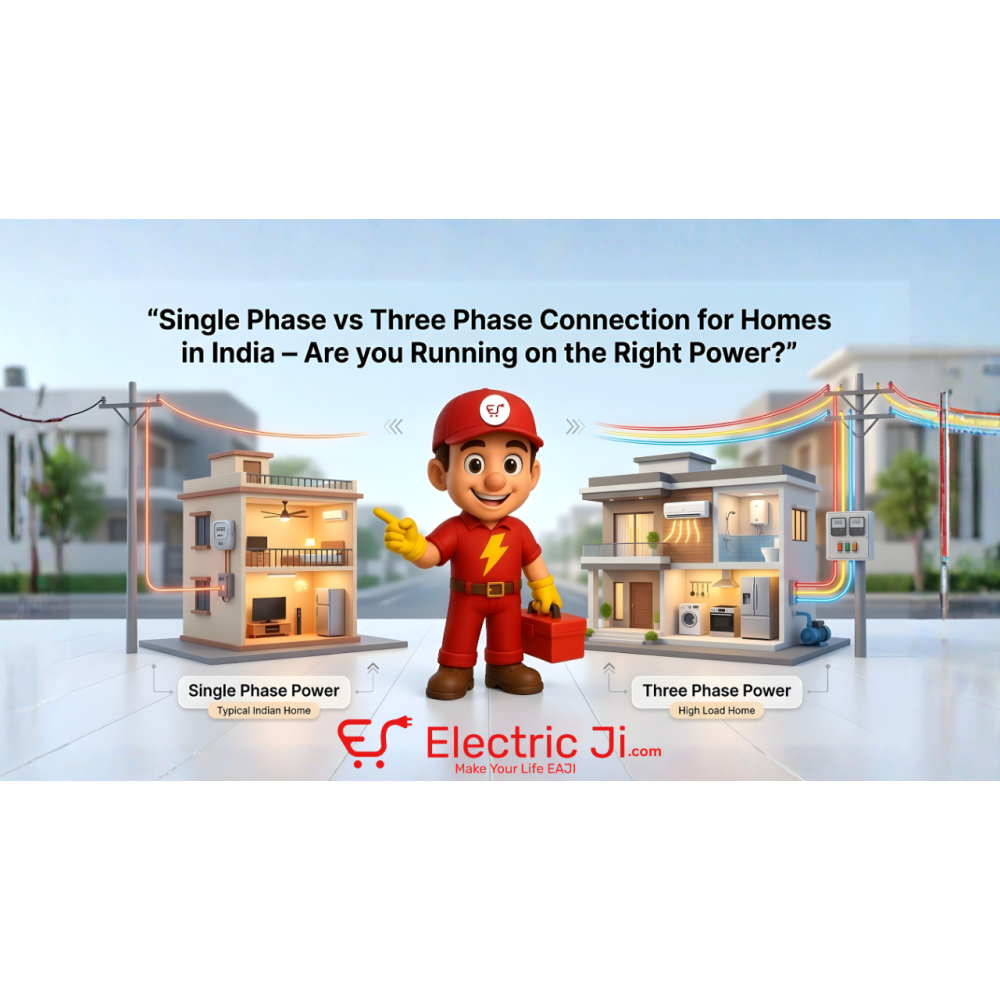
Most electrical problems in homes don’t start with sparks or burning smells.
They start with small, repeatable patterns.
When the AC starts, the lights dim slightly.
Switch on the geyser with other appliances, and the power trips.
In the evening, fans slow down when everything is running.
Individually, these issues look minor. Together, they point to something most homeowners never check, whether their power connection type can actually handle their real usage.
In India, many homes continue running on single-phase connections even after appliance demand increases. More ACs, more geysers, heavier kitchen equipment, but the same original connection.
The result is not immediate failure. It is gradual electrical stress.
Before blaming wiring quality or appliance brands, there is a more basic question:
Is your home running on the right phase connection for the load you are putting on it?
This is where the difference between single-phase and three-phase power becomes critical not as a technical detail, but as a capacity decision that directly affects safety, stability, and long-term reliability.
Single - Phase vs Three - Phase (Quick Comparison)
|
Feature |
Single Phase |
Three Phase |
|
Power Supply |
1 live, 1 neutral |
3 live, 1 neutral |
|
Suitable Usage Load |
Up to 5 – 7 kW |
Above 6 – 7 kW (can go 10 kW+) |
|
Suitable For |
Basic to moderate residential usage like 1 AC at a time, 1 geyser, refrigerator, TV, washing machine, microwave or induction (used separately), lights and fans |
Heavy simultaneous residential / commercial usage like 2–3 ACs together, 2–3 geysers, induction + oven + dishwasher together, washing machine + dryer, EV charger, full lighting and appliance load at once |
|
Capacity |
Lower capacity |
Higher capacity |
|
Voltage Stability |
More voltage drop under load |
More stable under high load |
|
Setup Cost |
Lower setup cost |
Higher initial setup cost |
|
Common Usage |
1BHK, small 2BHK homes |
Large 2BHK, 3BHK, villas |
If your total connected load regularly crosses 6 - 7 kW, single-phase may start operating near its limit.
What Is Single Phase Connection?
Single-phase power uses 1 live wire and 1 neutral wire to deliver electricity. It is the most common electricity supply provided in Indian residential buildings.
It is designed for moderate and predictable household usage.
Typical Load Capacity
Most residential single-phase connections support approximately 5 - 7 kW, depending on sanctioned load from the electricity board.
Suitable For
Single-phase works well for:
-
1BHK homes
-
Small to moderate 2BHK homes
-
1 AC used at a time
-
1 geyser used occasionally
-
Refrigerator
-
TV
-
Washing machine
-
Mixer grinder
-
Microwave oven
-
Induction cooktop (used alone, not with other heavy appliances)
Where Single Phase Becomes a Problem
Issues begin when:
-
2 ACs run together daily
-
Geyser + induction + AC operate at the same time
-
Load crosses 6 kW frequently
-
You plan appliance usage to avoid tripping
Single-phase does not fail suddenly. It slowly reaches its limit.
What Is Three Phase Connection?
Three-phase power uses 3 live wires instead of 1. The electrical load is distributed across 3 lines, reducing stress on any single conductor.
This allows better load balancing and improved stability.
It is no longer limited to commercial spaces. Many modern residential homes require it due to increased appliance usage.
Higher Load Capacity
Three-phase residential connections typically handle:
-
7 kW to 10 kW and beyond
-
Multiple heavy appliances operating simultaneously
Suitable For
Three-phase is practical for:
-
2–3 ACs running daily
-
2–3 geysers (2 kW each) operating regularly
-
Induction cooktop + oven + dishwasher together
-
Large 3BHK homes
-
Villas and independent houses
-
Home offices with continuous high-power equipment
-
EV charger installations
Three-phase is not about luxury. It is about managing higher demand safely.
What Are the Benefits of Three Phase Connection?
-
Better Load Distribution
Electricity is shared across 3 lines instead of stressing 1.
-
Improved Voltage Stability
Lights and fans remain stable even when heavy appliances start.
-
Reduced MCB Tripping
The system handles combined load more efficiently.
-
Lower Wiring Stress
Balanced current reduces continuous overheating.
-
Future-Ready Setup
Easier to add appliances without upgrading again soon.
-
Better Appliance Protection
Stable supply protects compressors and electronic boards.
Signs You May Need Three Phase Connection or Increase Your Load
-
MCB tripping frequently
-
Lights dimming when AC starts
-
Fans slowing when multiple appliances run
-
Running 2+ ACs daily
-
Installing high-power kitchen appliances such as induction cooktop (1.5–2 kW), electric oven (2–3 kW), dishwasher (1–1.5 kW), or microwave oven (1–1.5 kW)
-
Planning EV charging
-
Sanctioned load close to its approved limit
If you are adjusting appliance usage to avoid tripping, your connection is already under pressure.
Appliance Usage Matters More Than Apartment Size
When deciding between single-phase and three-phase power, total connected load (in kW) matters more than the number of bedrooms.
Below is a practical classification with approximate load ranges:
Standard Usage (Up to 3 kW)
Typical connected load: 1.5–3 kW
5 - 8 lights and 3 - 4 fans
1 refrigerator (0.2–0.4 kW)
1 TV (0.1–0.2 kW/hour)
1 washing machine (0.5–1 kW)
1 AC (1–1.5 ton) used occasionally (1–1.8 kW when running)
Suitable for most small households with limited simultaneous heavy usage.
Medium Usage (3–6 kW)
Typical connected load : 3 - 6 kW
2 ACs (1 - 1.5 ton each, 1 - 1.8 kW each)
2 geysers (2 kW each)
1 induction cooktop (1.5 - 2 kW)
1 washing machine
Standard lighting and refrigerator load
If 2 - 3 heavy appliances run together, load can quickly cross 5 kW.
High Usage (Above 6 kW)
Typical connected load: 6–10 kW or more
3 ACs (with at least 2 running simultaneously)
3 geysers (2 kW each)
1 induction cooktop (2 kW)
1 oven (2–3 kW)
1 dishwasher (1–1.5 kW)
Washing machine, refrigerator, lighting, and fans
Simultaneous usage can easily exceed 7–8 kW, where three-phase power is often recommended.
For example, a 2BHK with a connected load of 7 kW (3 ACs, 3 geysers, induction cooktop, and oven) may require three-phase power more urgently than a 3BHK with a 2.5 kW load under standard usage.
The decision should always be based on total connected load and simultaneous appliance usage, not apartment size alone.
What Is the Cost Difference in India?
Cost is the main reason people delay upgrading.
Installation Cost
Upgrading from single-phase to three-phase generally includes:
Load enhancement request
Security deposit adjustment
Meter replacement
Minor wiring modifications
Approximate range: ₹8,000 – ₹25,000, depending on state and sanctioned load.
Monthly Fixed Charges
Three-phase connections have slightly higher fixed charges.
But the difference is minor compared to:
Appliance repair costs
Repeated electrician visits
Electrical safety risks
Risks of Choosing the Wrong Connection
When your connection type does not match your usage, stress builds silently.
Overheating Wires
Continuous overload generates internal heat in wiring. This is rarely visible until damage happens.
Fire Risk
Loose terminals and overloaded circuits are common causes of residential electrical fires.
Appliance Damage
Voltage instability affects compressors, motors, and electronic boards.
Constant Tripping
Frequent breaker trips are not random. They are safety responses.
Electrical systems usually tolerate overload quietly, until they don’t.
How Electric Ji Helps You Choose the Right Power Setup
Most homeowners never calculate how much total power their home is actually using before adding new appliances.
At Electric Ji, electricians don’t push upgrades just to increase billing. They first explain your real power usage, your sanctioned load, and whether you truly need to upgrade to three-phase or increase your load.
There is no commission-based selling. Electric Ji does not pay electricians extra to recommend higher load or unnecessary upgrades. Their goal is to guide, not to oversell. Customers are free to choose products based on what their home actually needs.
Even the filters on the platform are designed according to real household requirements. Products are grouped based on load capacity, compatibility, and safety so you can make informed decisions easily.
Electric Ji also uses wall-analysis technology to check how your electrical load is behaving inside your home walls. This helps detect stress points in wiring and load imbalance without guessing.
The goal is not just to stop MCB tripping. It is to make sure your connection type, wiring, and appliance usage are properly matched so your home runs safely and smoothly every day.
Final Clarity
Single-phase is not wrong.
Three-phase is not automatically better.
The correct choice depends on :
Total load running together
Future expansion plans
Appliance growth
Electricity problems rarely appear without warning.
They build quietly as usage increases.
Choosing the right phase connection early prevents daily inconvenience, appliance damage, and long-term safety risks.
If your home feels electrically restricted, it’s not random.
It’s a signal.
Frequently Asked Questions (FAQs)
1. What is the main difference between single-phase and three-phase connection?
Single-phase uses 1 live wire and is suitable for moderate household loads, while three-phase uses 3 live wires and distributes load more efficiently for higher power demand.
2. How do I know if my home needs a three-phase connection?
If you regularly run multiple heavy appliances like 2–3 ACs, geysers, induction cooktops, or an EV charger simultaneously and experience frequent tripping or voltage drop, you may need three-phase.
3. What is the maximum load a single-phase connection can handle in India?
Most residential single-phase connections handle around 5 - 7 kW, depending on sanctioned load from the electricity board.
4. Can I run two ACs on a single-phase connection?
Yes, but only if total load stays within sanctioned limits. Running two ACs with other heavy appliances may cause frequent tripping.
5. Is three-phase electricity only for commercial buildings?
No. Many modern residential homes, especially large 2BHKs, 3BHKs, and villas, use three-phase due to higher appliance usage.
6. Does three-phase connection increase electricity bills?
Energy consumption charges remain the same per unit. However, fixed monthly charges may be slightly higher.
7. What happens if I overload a single-phase connection?
You may experience MCB tripping, voltage fluctuations, overheating wires, and possible appliance damage over time.
8. Can I upgrade from single-phase to three-phase later?
Yes. You can apply for a load enhancement and connection upgrade through your local electricity board.
9. How much does it cost to upgrade to three-phase in India?
Costs typically range between ₹8,000 and ₹25,000 depending on state, sanctioned load increase, and wiring modifications required.
10. Is three-phase more stable than single-phase?
Yes. Three-phase provides better voltage stability under high load conditions.
11. Does apartment size decide whether I need three-phase?
No. The decision depends on total connected load and simultaneous appliance usage, not just the number of bedrooms.
12. Can I install an EV charger on a single-phase connection?
Low-capacity EV chargers may work on single-phase, but faster or higher-capacity chargers often require three-phase.
13. Will three-phase prevent MCB tripping completely?
It reduces load stress significantly, but proper wiring design and correct load distribution are still essential.
14. Is three-phase safer than single-phase?
Both are safe when properly installed. Three-phase becomes safer for high-load homes because it reduces overload stress.
15. What is the sanctioned load and why does it matter?
Sanctioned load is the maximum approved power limit assigned by your electricity board. Exceeding it regularly can cause tripping and penalties.
16. Can voltage fluctuations damage appliances?
Yes. Frequent voltage drops and instability can damage compressors, motors, and electronic control boards.
17. Does installing more appliances automatically mean I need three-phase?
Not necessarily. It depends on how many heavy appliances run at the same time.
18. Is three-phase future-proof?
Yes. It allows easier expansion if you plan to add more ACs, kitchen appliances, solar systems, or EV charging.
19. Can solar panels work with single-phase?
Yes, small residential solar systems work on single-phase. Larger systems may require three-phase.
20. Should I upgrade before problems start?
Yes. Upgrading based on calculated load is better than waiting for repeated tripping, wiring stress, or appliance damage.