
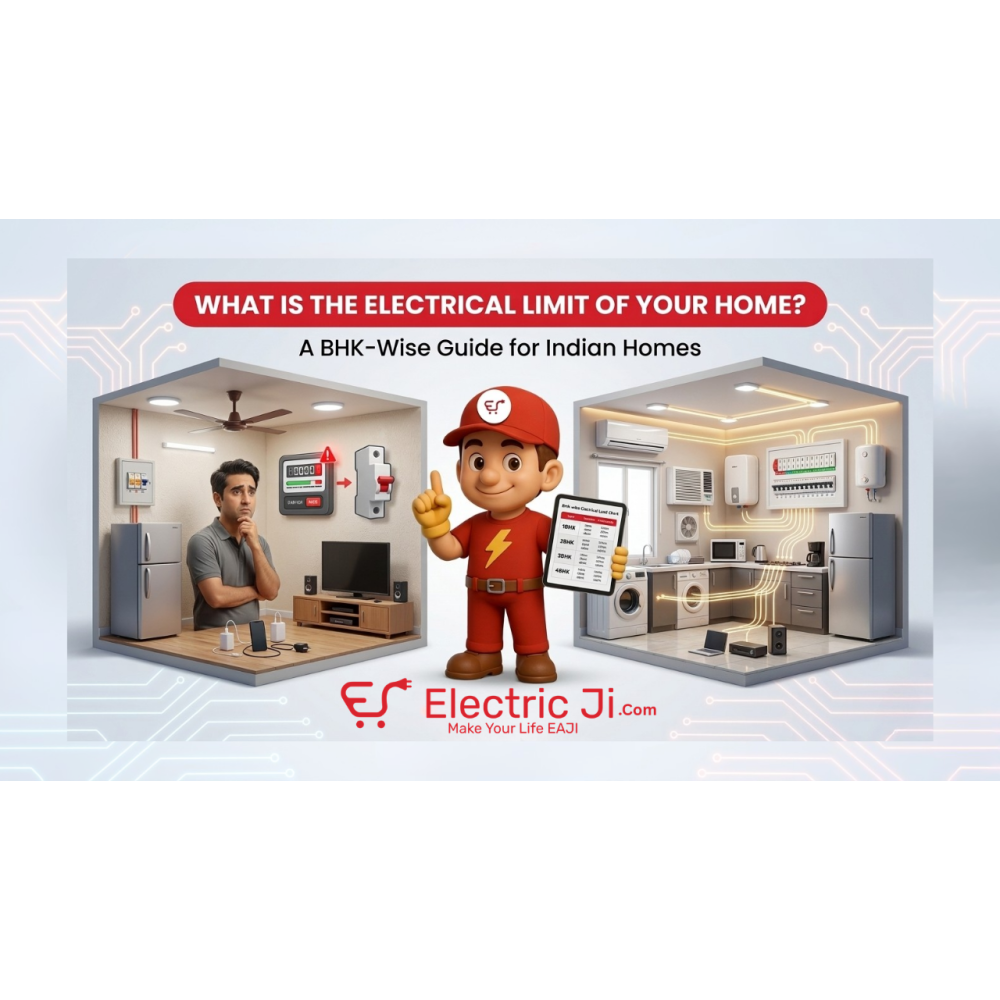
Most homeowners don’t think about electrical limits until something starts going wrong. Lights dim when appliances turn on, fans slow down, power trips unexpectedly, or certain appliances refuse to run together. These issues are often brushed off as “normal,” but they’re not.
Every home has a fixed electrical limit. That limit does not increase automatically as families grow, lifestyles change, or appliances are added. When daily usage quietly crosses this limit, electricity stops behaving smoothly and starts showing warning signs.
What Is the Electrical Load of a House?
Are Electrical Load and Electrical Limit the Same?
Electrical load is how much electricity your home is using at a particular moment.
Electrical limit is the maximum electricity your home can safely handle.
A home works reliably only when the load stays within the limit. When usage repeatedly crosses it, stress builds inside the system even if everything appears “fine” on the surface.
Electrical Load vs Electrical Limit
|
Electrical Load |
Electrical Limit |
|
Electricity used at a moment |
Maximum safe capacity |
|
Changes throughout the day |
Fixed unless upgraded |
|
Depends on appliance usage |
Depends on wiring & system design |
Now how to Understand Your Home’s Electrical Limit (By Flat Size & Square Footage)?
Most people don’t know their home’s electrical limit because it’s not written anywhere inside the house. But you can still get a clear idea by looking at the size of the home and how electricity behaves during daily use.
1 BHK Homes (Up to 600 sq ft)
Most 1 BHK flats are not newly built anymore. The wiring inside them is often 10 - 20 years old and was designed for lights, fans, and maybe a fridge. Today, even a single AC, microwave, and washing machine change the load completely. The problem isn’t visible because the wires are inside the walls. Old insulation weakens over time, and capacity never upgrades automatically. If you haven’t checked the wiring in years, you are assuming it can handle today’s appliances, which is a risk.
2 BHK Homes (700–1,200 sq ft)
2 BHK flats usually come with standard sanctioned load and wiring that matches the original builder’s plan. On paper, it looks strong and “as per requirement.” But that requirement was calculated at possession time not after adding extra ACs, geysers, ovens, and charging points over the years. The wiring may be decent, but if it hasn’t been inspected since installation, you don’t actually know its current condition. Standard wiring without periodic checks becomes a hidden liability.
3 BHK Homes (1,200–1,800 sq ft)
In 3 BHK homes, appliance growth is continuous. More family members, more ACs, more kitchen appliances, more devices. The wiring stays the same, but the load keeps increasing. Over long-term usage, internal wiring heats repeatedly. Even if nothing trips, internal stress builds silently. This category faces gradual overload risk, not sudden failure. If the wiring hasn’t been evaluated after years of increasing consumption, you’re operating beyond the original design without knowing it.
4 BHK Homes (2,000–3,500 sq ft)
Modern 4 BHK homes demand more power like home offices, large kitchens, multiple ACs, entertainment systems. The issue is that many new constructions focus on meeting current visible requirements, not future expansion. Builders often provide wiring sufficient for handover conditions. But what happens when usage doubles in five years? If the internal wiring and panel capacity were not designed for expansion, future upgrades become risky and expensive.
5 BHK Homes & Bungalows (3,500 sq ft and above)
Large homes grow fast, additional floors, outdoor lighting, pumps, automation systems, EV chargers. Electrical requirements increase rapidly and sometimes temporarily (events, guests, renovations). If wiring planning was done only for initial occupancy, the system gets stressed quickly. In these homes especially, assuming “big house = strong electrical system” is dangerous. Without checking internal wiring strength and future capacity, the risk multiplies with scale.
The Real Pain Point Across All BHK Sizes
Wiring is hidden. It ages. It doesn’t upgrade itself when your lifestyle upgrades.
New flats are often wired for present demand, not future expansion. Old flats are running on infrastructure designed for another era.
If wiring is not inspected, measured, and evaluated periodically, you are operating on assumption and electrical systems don’t fail loudly first. They fail after silent stress.
What Electric Ji Offers To Solve These Problems?
Electric Ji focuses on understanding how your home is actually used today and aligns the electrical system to match that reality. In most households, appliances keep increasing regularly in small units by family members or co-owners and this gradual increase silently raises the electrical load. Electric Ji helps identify how this growing usage impacts the system before it becomes a failure.Through a Home Safety Pack for every type of household, with scheduled safety checkups conducted four times a year, the entire electrical system from wiring to load points is reviewed to catch stress, wear, or risk early. This proactive approach ensures problems are addressed before they turn into tripping, damage, or safety hazards.
Why Do Power Trips and Dimming Happen?
These are warning signals, not random faults, and ignoring them is very dangerous. Power trips and dimming are safety responses. When too many appliances run together and electrical demand exceeds safe limits, breakers trip and voltage drops to protect the system from overheating or damage.
How Electric Ji Helps Here ?
Instead of treating power trips as isolated incidents, Electric Ji looks at patterns when tripping happens, what appliances are running, and how frequently voltage drops occur. By analysing these usage patterns during safety checkups, Electric Ji helps pinpoint the exact cause of instability and prevents repeated tripping from turning into long-term damage or safety risks.
Old Wiring vs Modern Appliances
Many homes still rely on wiring planned years ago, while appliance usage has increased steadily over time. This mismatch creates continuous electrical pressure, which is very dangerous
|
Old Wiring |
Modern Appliances |
|
Designed for limited usage |
Designed for continuous usage |
|
Fewer appliances |
Multiple appliances together |
|
Struggles under load |
Needs stable supply |
How Electric Ji Helps Here
Electric Ji checks whether existing wiring is being pushed beyond what it was originally designed to handle. During safety inspections, signs of overheating, insulation wear, loose joints, and uneven load distribution are identified, issues that usually remain hidden inside walls. By flagging these risks early and guiding timely corrections, Electric Ji helps prevent wiring failures that could otherwise lead to electrical fires or appliance damage.
Single - Phase vs Three - Phase Power
Single-phase and three-phase power refer to how electricity is supplied to a home.
|
Single-Phase Power |
Three-Phase Power |
|
Lower capacity |
Higher capacity |
|
Voltage drops under load |
Stable during heavy usage |
|
Suitable for basic needs |
Suitable for higher-demand homes |
How Electric Ji Helps Here
This is important because fires and all happen at houses because of this usage or trip accidents happen, even the over usage of these doesn’t count in insurance. Electric Ji helps homeowners understand whether their current power supply matches real usage. Instead of guessing or overloading a single-phase setup, the right power planning is guided based on daily demand.
How Many Appliances Can Run Together?
There is no fixed number. Stability is the indicator. If appliances run together without dimming or tripping and within current power apply, and the internal house wiring and transmitters have capacity to handle it, then the system is healthy. If electricity becomes unstable the moment appliances overlap, the home has reached its electrical limit.
How Electric Ji Helps Here
Electric Ji evaluates how appliances are used together in real life, not in theory. Regular inspections help ensure daily routines don’t quietly push the system beyond safe limits.
Sanctioned Load vs Home Electrical Capacity
|
Sanctioned Load |
Home Electrical Capacity |
|
Approved by electricity provider |
Determined by internal wiring |
|
Mentioned on the bill |
Hidden inside the home |
|
Can be increased on paper |
Requires physical upgrades |
|
Does not ensure safety |
Directly affects safety |
How Electric Ji Helps Here
Electric Ji bridges the gap between approved load and real capacity by inspecting the actual electrical system. This ensures homes aren’t approved on paper but under-prepared in reality.
Residential Electrical Load Limit in India
In India, most homes do not know what their electrical limit is, how to observe it, or what effects crossing it can have. This limit is defined by internal wiring, distribution boards, and circuit design, not by the number of appliances inside the house.
In practical terms:
-
People don’t know their electrical limit load and keep bringing new appliances into the home over time, unknowingly pushing the system closer to failure.
-
Mid-size homes need higher capacity
-
Large flats and independent houses require strong electrical systems by default
The challenge is that this limit is not visible anywhere inside the house. Homeowners usually discover it only when appliances can’t run together or power becomes unstable. Increasing sanctioned load alone does not upgrade this internal limit.
The Bigger Picture
Electrical fires in homes or buildings rarely happen by accident. In most cases, they occur because electrical limits are crossed repeatedly over time. Continuous overload, weak connections, and aging insulation build silent risk inside the system until one weak point fails. Many such incidents are not covered by insurance, leaving homeowners exposed to serious financial loss.
With regular safety inspections, early risk detection, and proper guidance, Electric Ji helps reduce these risks. Verified electricians inspect the entire electrical system, including wiring inside the walls, load distribution, switchboards, and the distribution panel to detect hidden stress before it becomes dangerous. This structured approach ensures homeowners are protected from unseen hazards, unexpected failures, and unsafe electrical conditions.
FAQs
1. How do I calculate the electrical load of my house in India?
Add the wattage of all appliances that may run at the same time. Convert watts to kilowatts (divide by 1000). The total gives an approximate electrical load requirement for the house.
2. What is the typical electrical load for a 1 BHK flat in India?
Most 1 BHK flats operate comfortably within 2–3 kW if they mainly use lights, fans, refrigerator, and small appliances. Adding an AC or microwave increases the required load significantly.
3. What electrical load is required for a 2 BHK flat?
A typical 2 BHK home usually requires 3 - 5 kW depending on appliances like ACs, geysers, washing machines, and kitchen equipment.
4. What electrical capacity is required for a 3 BHK house?
A 3 BHK house with multiple ACs, geysers, and kitchen appliances may require 5 - 8 kW or more depending on the number of appliances running together.
5. How many ACs can run in a 2 BHK flat?
Usually 1 - 2 AC units can run comfortably in a standard 2 BHK setup if the wiring and sanctioned load support the demand. Running more units may require increased sanctioned load or electrical upgrades.
6. How many appliances can run together in a house?
There is no fixed number. The limit depends on the capacity of wiring, circuit design, and sanctioned load. If lights dim or breakers trip when appliances run together, the electrical limit is being exceeded.
7. What is sanctioned load in electricity bills in India?
Sanctioned load is the maximum electricity usage approved by the electricity distribution company for a property.
8. Does increasing sanctioned load upgrade my home wiring?
No. Increasing sanctioned load only increases supply availability from the electricity provider. Internal wiring and distribution boards must be upgraded separately if required.
9. What happens if electrical load exceeds the sanctioned limit?
The electricity provider may charge penalties, and the internal electrical system may face frequent tripping, overheating, or voltage drops.
10. What are signs that a house has electrical overload?
Common signs include:
-
Frequent breaker trips
-
Lights dimming when appliances start
-
Warm switchboards or burning smell
-
Appliances not working together
11. Can old house wiring support modern appliances?
Many older homes were wired for basic appliances. Modern appliances such as ACs, ovens, induction cooktops, and geysers often exceed the original wiring capacity.
12. What is the difference between electrical load and electrical capacity?
Electrical load is the electricity being used, while electrical capacity is the maximum electricity the system can safely handle.
13. When should a house upgrade to three-phase electricity?
Homes with multiple ACs, large kitchens, elevators, pumps, EV chargers, or high electrical demand often benefit from three-phase supply.
14. Is single-phase electricity enough for a house?
Single-phase supply works for small homes and moderate usage, but large homes with heavy appliances may require three-phase power.
15. Why do lights dim when AC or geyser turns on?
This usually indicates high electrical demand causing voltage drop, which can occur when the system is close to its electrical limit.
16. How often should home electrical wiring be inspected?
Electrical systems should ideally be inspected every 1 - 2 years, especially in homes older than 10 years or homes where new appliances are added regularly.
17. Can overloaded wiring cause electrical fires?
Yes. Continuous overload causes wires to heat up, weaken insulation, and eventually create fire hazards inside walls.
18. Do bigger houses always have higher electrical capacity?
Not always. Many large homes are wired only for the initial builder setup, which may not support future appliances or expansions.
19. Why do breakers trip when multiple appliances run together?
Breakers trip as a safety mechanism when electrical current exceeds the safe capacity of the circuit.
20. Why should homeowners know their home’s electrical limit?
Knowing the electrical limit helps homeowners prevent overload, avoid appliance damage, reduce fire risk, and maintain stable electricity usage.